This post contains affiliate links. As an Amazon Associate I earn from qualifying purchases, at no extra cost to you. Thank you for supporting Diynify!
If you want holiday decor that feels more sculptural than flat, 3D paper Christmas tree ideas give you a lot to work with. They can stand on a mantel, fill a centerpiece, glow with fairy lights, or fold away after the season, all while keeping that handmade paper texture that makes Christmas decor feel warm instead of mass-produced.
The best part is that “3D” can mean very different things. Some trees get their depth from folds, some from stacked layers, some from open geometric structure, and some from repeated units that build real volume. That makes it easier to choose your project by the look you want, the paper you have, and how much assembly you feel like doing.
1. Accordion Fold Tabletop Tree
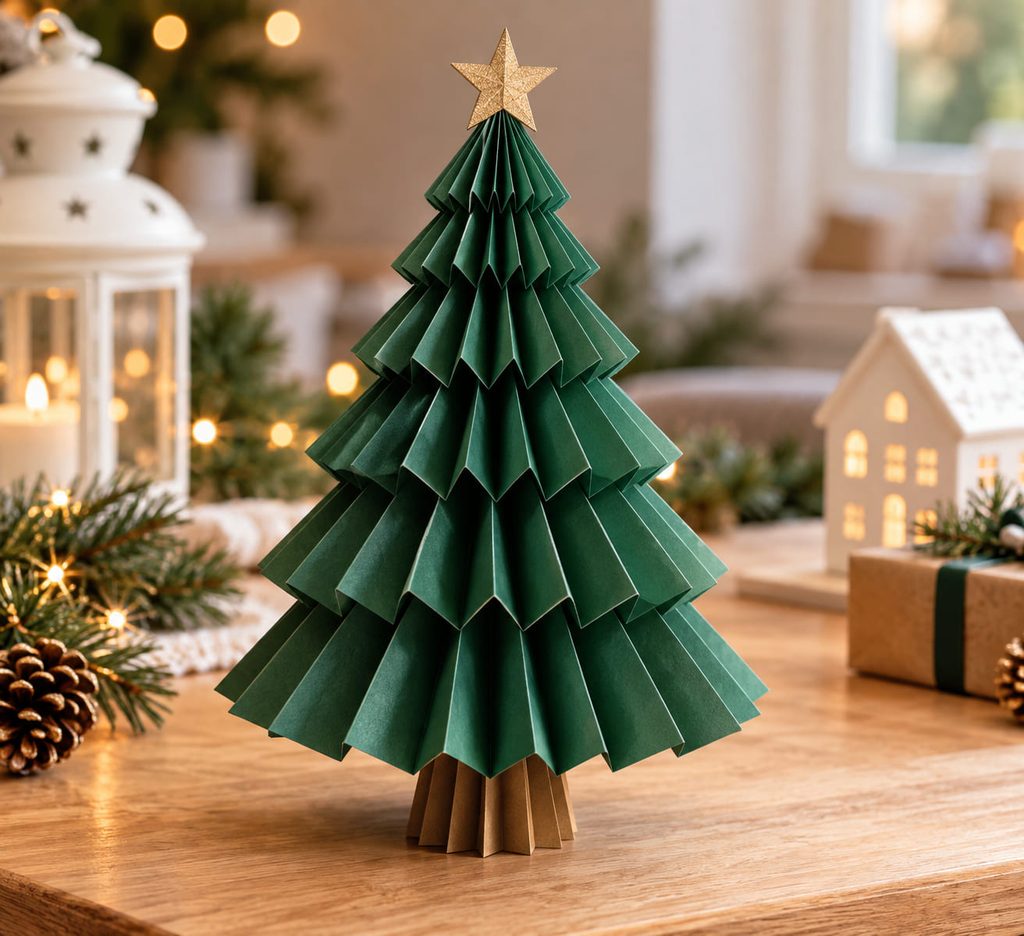
A fold-out accordion tree is one of the easiest ways to get real depth without building a heavy structure. You create repeated mountain-and-valley folds across a tall triangle or layered strip, then open the piece until it stands in a zigzag shape. The finished tree feels dimensional from every angle, and the repeating folds catch light nicely if you use metallic cardstock or paper with a subtle sheen.

This idea works especially well when you want something light, fast, and easy to store. The biggest advantage is that it folds almost flat once the season is over, so it suits small-space decorating better than bulkier paper trees. If you want a cleaner silhouette, keep the edges crisp and use a small paper trunk or folded base tab so the tree stays upright without leaning.
2. Slotted Two-Piece Standing Tree
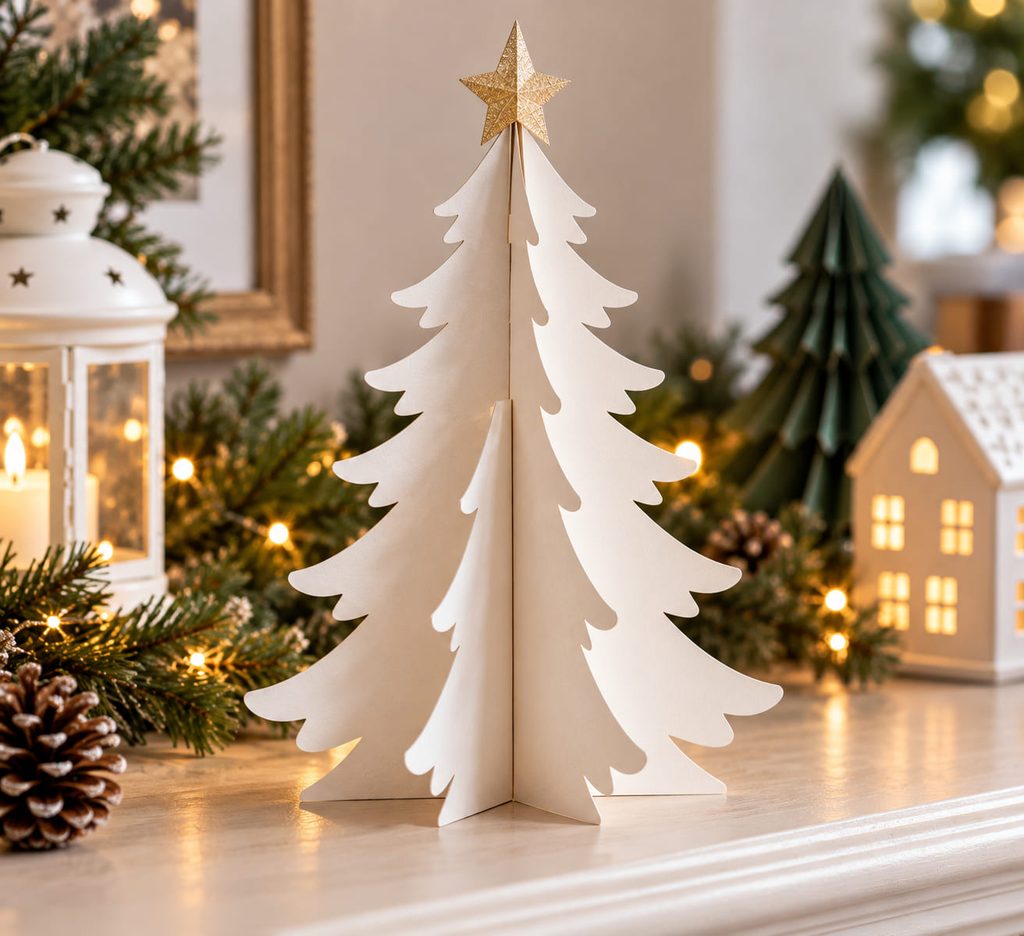
Instead of building volume through many folds, a slotted standing tree gets its shape from two mirrored pieces that slide together through center cuts. One piece locks vertically from the top, the other from the bottom, creating a freestanding cross structure that reads as a full tree once both profiles are aligned.
This is a great choice for minimalist holiday decor because the finished form looks graphic and clean even with plain green cardstock or white paper. It also scales well: a small version works as place-setting decor, while a larger one can sit on an entry console. If you cut branch edges with a little irregularity rather than making them perfectly smooth, the silhouette feels more like a stylized evergreen and less like a basic triangle.

3. Honeycomb Paper Christmas Tree Centerpiece
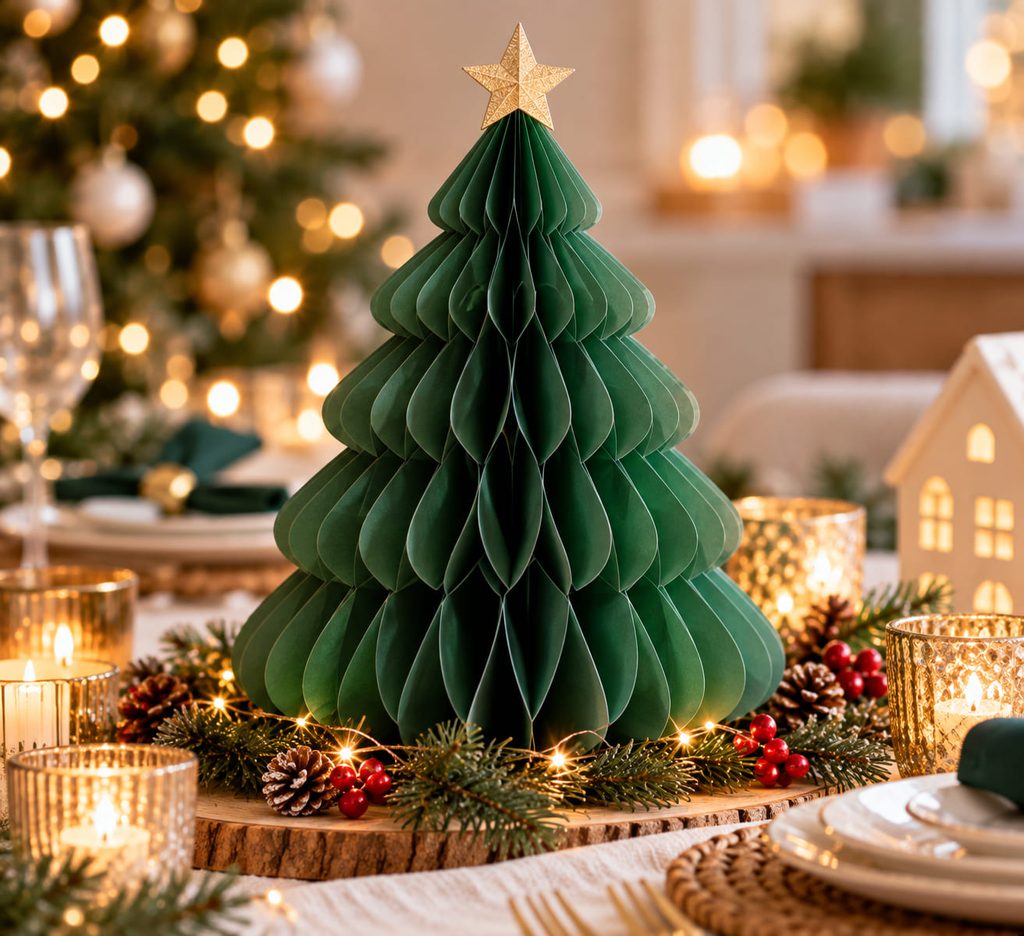
A honeycomb tree creates its depth by opening repeated fan-folded sections into a rounded, airy body. Once expanded, the tree feels full in a way flat paper never can, and the repeating cells give it a soft vintage holiday look that works especially well in centerpieces and shelf styling.
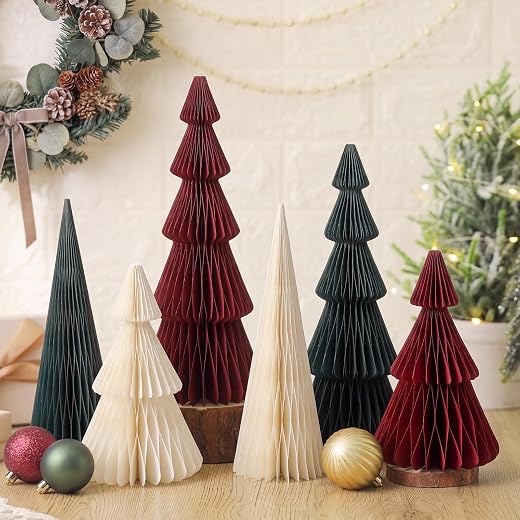
Because the structure depends on even spacing, this project looks best when the folds stay consistent from top to bottom. Thin paper opens more easily, but medium-weight paper usually holds the shape better over time. If you want the tree to read clearly from across the room, keep the outer outline simple and let the internal honeycomb texture be the detail rather than adding too many extra ornaments.
4. Stacked Cone Tier Tree
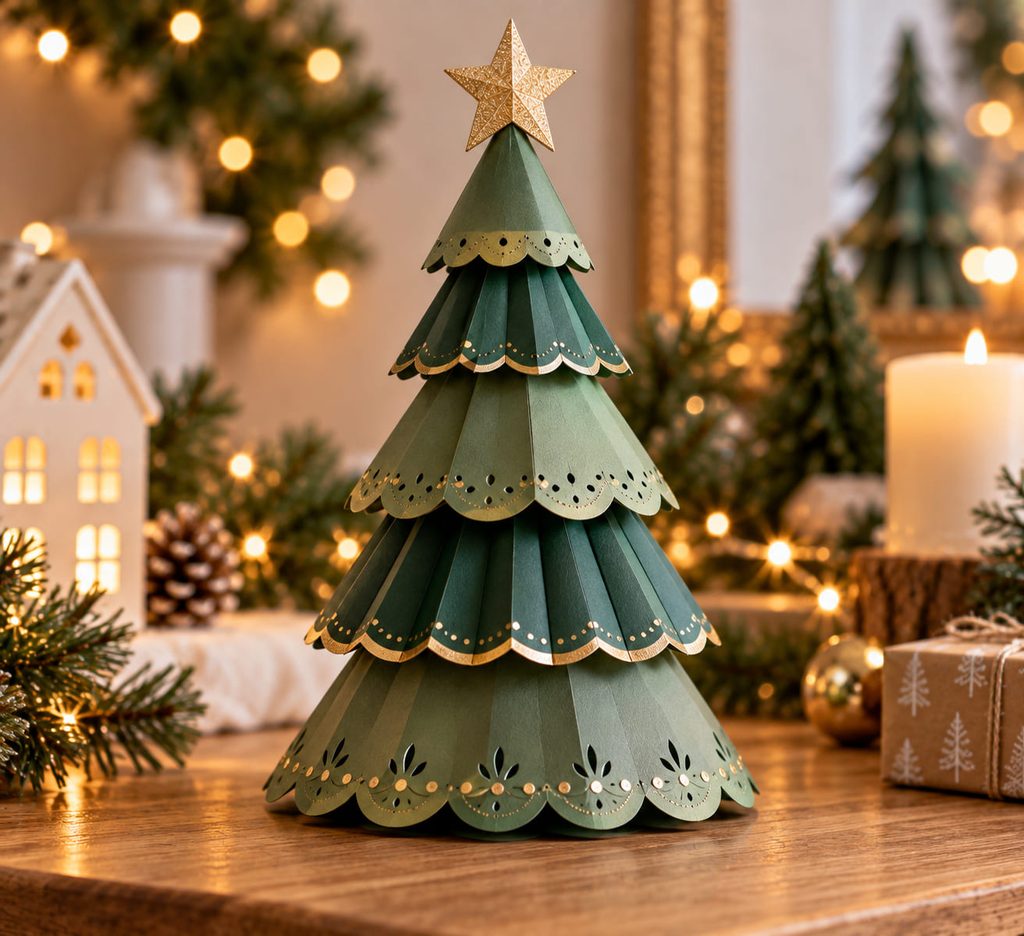
A stacked cone tree uses several paper cones in descending sizes to build a tiered evergreen shape. Each tier flares out slightly from the one above it, which creates a layered silhouette with real shadow lines instead of one smooth cone. That difference is what gives the piece more dimension and makes it feel closer to sculpted decor.
You can keep it sleek with solid cardstock, or make the tiers more expressive with scalloped rims, fringed edges, or tiny punched details. The main construction decision is how visible you want the separation between levels to be. Tight stacking gives you a cleaner modern tree, while leaving a little space between tiers emphasizes the layered effect and makes the 3D structure more obvious.

5. Layered Cardstock Tree with Spacer Depth
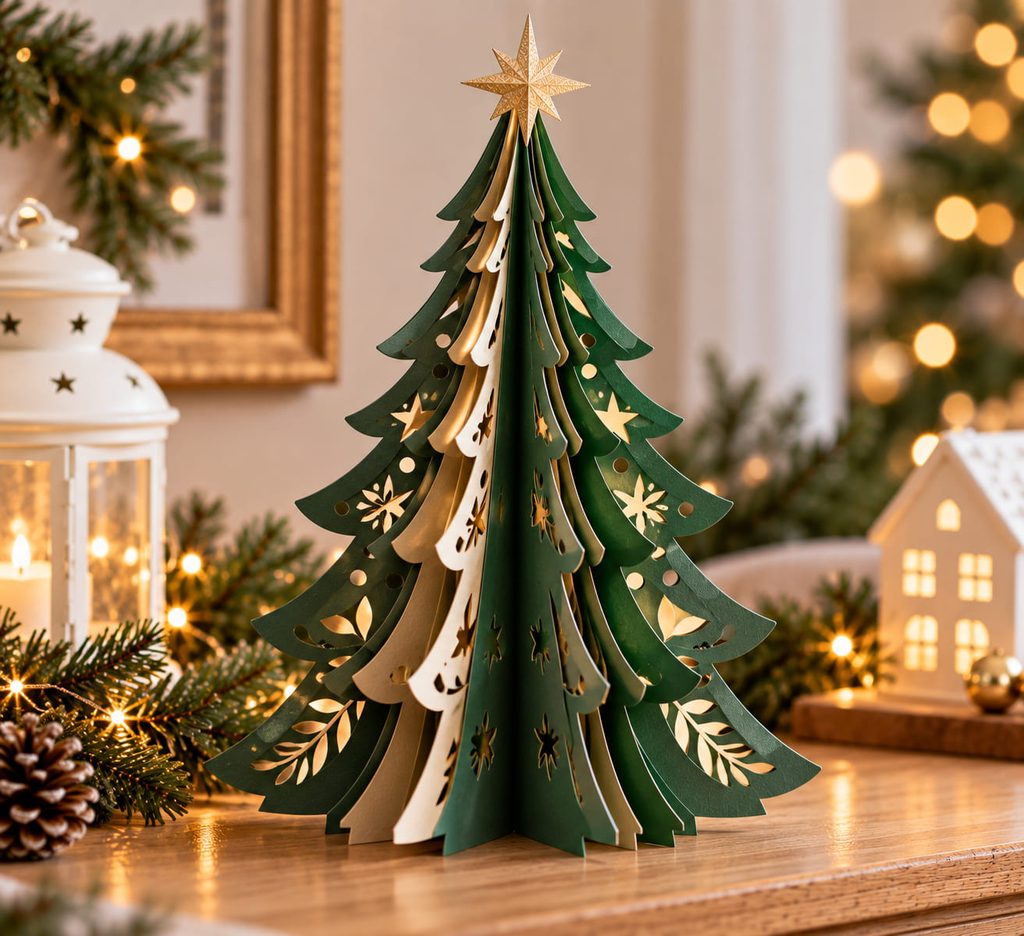
If you want a tree that looks architectural, layered cardstock is one of the strongest routes. Instead of folding one object, you cut several tree silhouettes and separate them with foam spacers, rolled paper columns, or hidden folded tabs. That creates visible depth between the layers, so the finished tree has real internal shadow and not just surface decoration.
This format is especially useful for adding cutout stars, branch openings, or negative-space patterns because those details become more dramatic when they sit across multiple planes. It also gives you a lot of control over thickness: four layers can look light and modern, while eight or more layers start to feel almost sculptural.
Depth Check: To keep the tree from looking compressed, the spacer thickness should be large enough to cast visible shadow but not so large that the layers disconnect visually. In most cases, a moderate gap looks more polished than either a paper-thin stack or a very chunky build.
6. Book Page Fan Tree

A book page tree gets its volume from repeated folded pages or page-like paper segments arranged around a center line or narrow spine. The texture is the real attraction here. Instead of aiming for a dense evergreen look, this design uses repetition, page edges, and warm paper tone to create a tree that feels soft, nostalgic, and a little rustic.
This is one of the best recycled-paper options because minor imperfections actually help the finished piece. Slightly yellowed pages, uneven print, and softly curled edges add character rather than looking messy. If you want the structure to stay balanced, keep the base wider than you think you need. Book-based trees can become top-heavy visually, so a stable footprint matters more here than on flatter designs.

7. Geometric Prism Tree
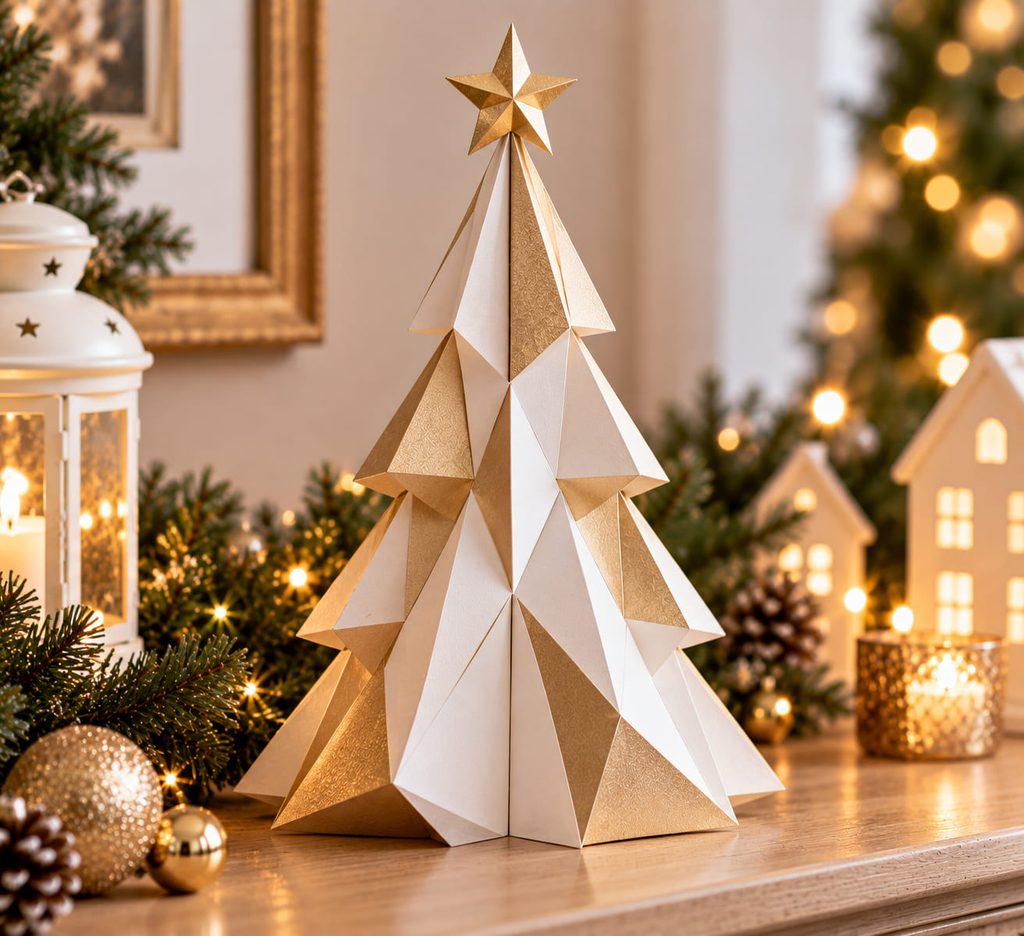
For a modern holiday look, a geometric prism tree uses faceted panels instead of curved or fluffy shapes. Think of triangular and trapezoid faces joined into a tapered form so the finished piece resembles a low-poly sculpture. This kind of tree looks especially striking in white, gold, silver, or deep forest green because the planar surfaces reflect light differently as the angles change.
The appeal of this design is precision. Clean scoring and accurate glue tabs matter more here than decorative extras, because any misalignment interrupts the faceted rhythm. If you enjoy a crisp, contemporary aesthetic, this tree gives you real dimension without relying on traditional branch texture at all.

8. Spiral Helix Tree

A spiral tree builds height through one continuous band or several graduated strips that wrap upward around a center support. The open structure keeps the silhouette light, so even a taller version does not feel visually heavy on a shelf or windowsill. From the side, the twist creates motion; from the front, it still reads clearly as a Christmas tree.
This idea is especially good when you want dimension without a lot of paper coverage. You can let the negative space do some of the design work, which makes the form feel elegant and a bit airy. The key is keeping the spiral rise even. If the spacing tightens too much near the top or opens too much near the bottom, the shape starts to feel accidental rather than intentional.
9. Quilled Cone Christmas Tree
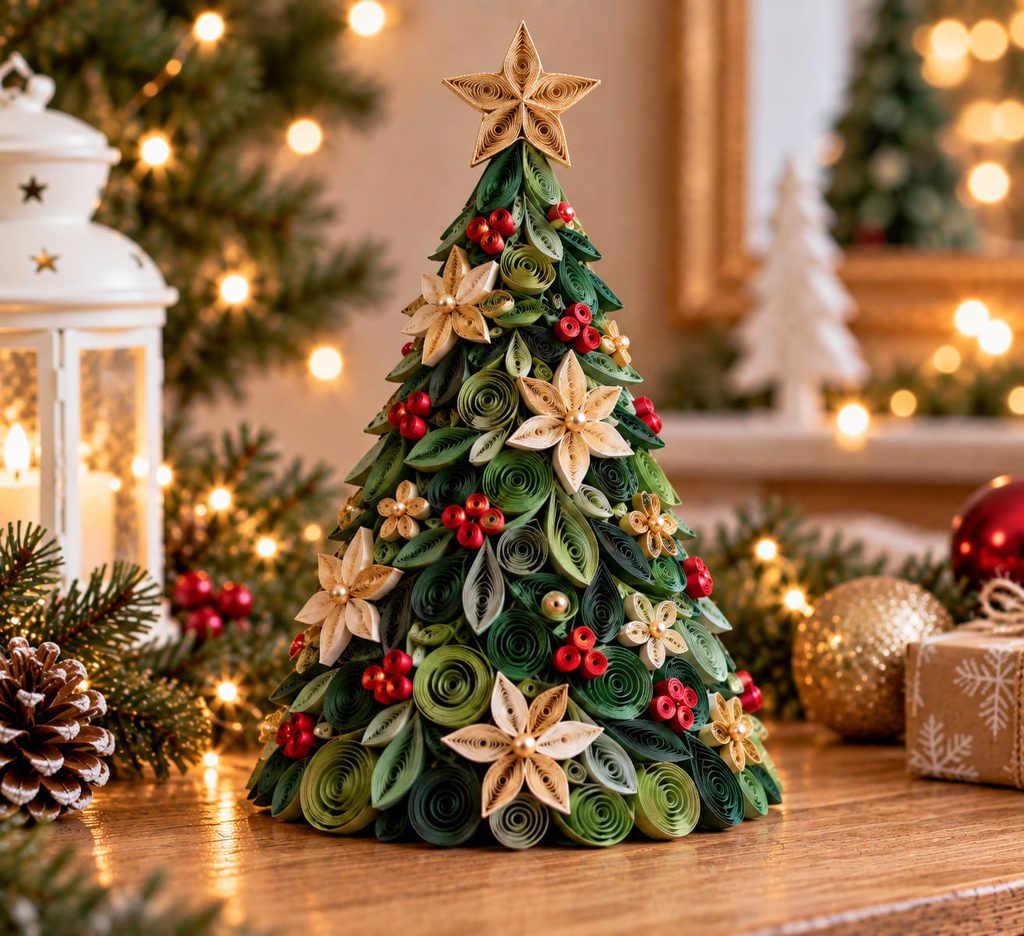
A quilled tree takes a basic conical form and covers or builds it with paper coils, teardrops, scrolls, and loose spirals. That gives you dimension on two levels: the tree itself is three-dimensional, and the surface is built from many raised paper elements that create texture and shadow up close.
This works best as a decorative display piece rather than a quick craft because the beauty comes from the density and variation of the quilled units. Tight coils make the surface feel structured, while looser shapes soften it. If you want a balanced result, repeat a limited set of quilled forms instead of inventing a new pattern for every section. Too much variation can make the surface look busy rather than intricate.
10. Woven Paper Strip Tree
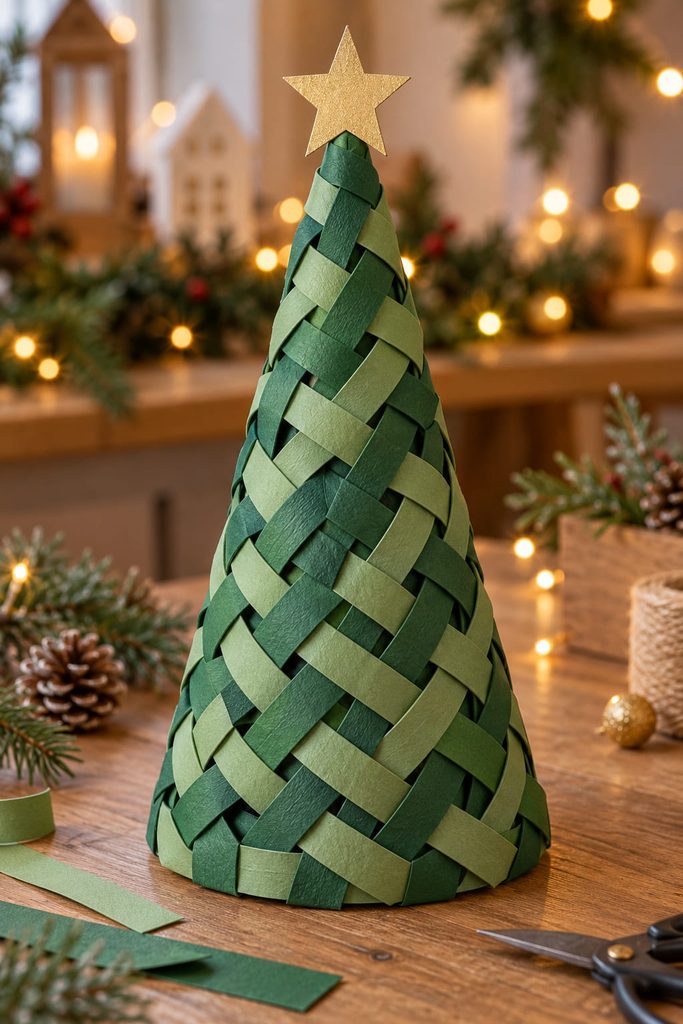
A woven paper tree stands out because the 3D effect comes from interlaced strips rather than stacked or folded mass. You can weave over-under strips around a tapered card form or build a woven panel first and wrap it into a tree body. Either way, the finished piece has tactile depth, visible pattern, and a handmade texture that feels different from smoother cardstock projects.
Because weaving introduces tension, the structure needs a clear frame or support to stay neat. Loose strips can bow outward or drift out of alignment if the base is too soft.
Helpful Supply List
- Medium cardstock or strong paper strips
- A tapered card core or triangular frame
- Double-sided tape or glue at start and finish points
- Clips or mini clothespins to hold the weave while drying
This is a great project if you want the tree to feel crafted in a visible way. The over-under rhythm becomes part of the design, so the construction method stays readable in the finished decor.
11. Layered Vellum Luminary Tree
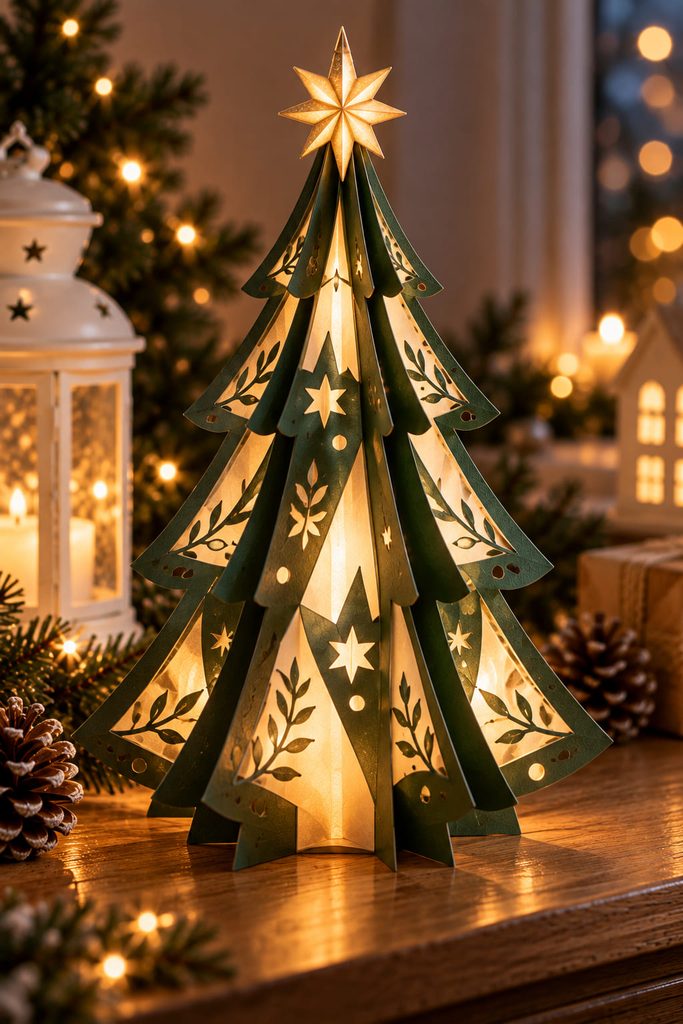
A luminary tree adds dimension through both structure and light. The outer shape can be a layered tree shell, a faceted form, or a cut-paper wrap, but the real magic comes from openings that let a warm LED source glow through vellum windows or translucent layers. That makes the tree feel deeper at night than it does in daylight.
This format is ideal for mantels and side tables where evening lighting matters. The most important design choice is where the light escapes. Small star cutouts make the glow look delicate, while larger branch openings make the silhouette more dramatic.
Safety Note: A paper luminary should use only cool LED tea lights or battery fairy lights. Real flames and hot bulbs are not a paper-craft option here.
12. Rosette Branch Christmas Tree
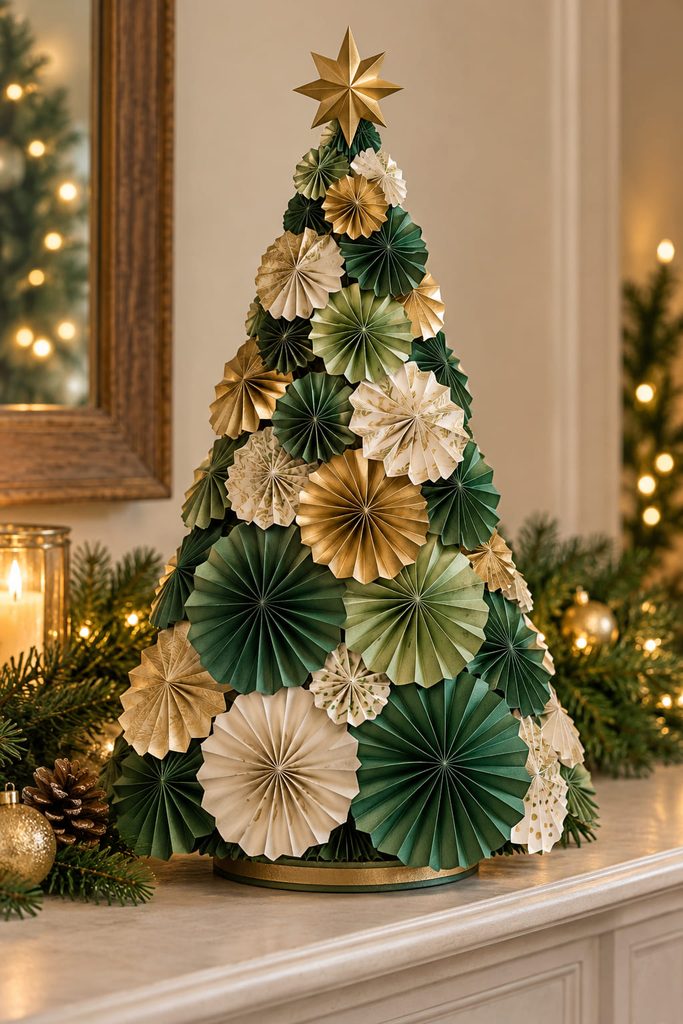
A rosette branch tree uses many folded paper rosettes attached to a cone base or central support so the finished tree feels full and layered. Unlike a simple cone, this design gets its volume from repeated circular forms overlapping like stylized branches. The result is decorative, festive, and especially effective when you mix print, solid color, and metallic accents.
The success of this project depends on scale variation. If every rosette is the same size, the tree can start to look flat despite all the folding. A mix of larger lower rosettes and smaller upper ones creates a more natural taper. This also helps the piece read as a tree first and a collection of paper fans second.
13. Modular Origami Christmas Tree
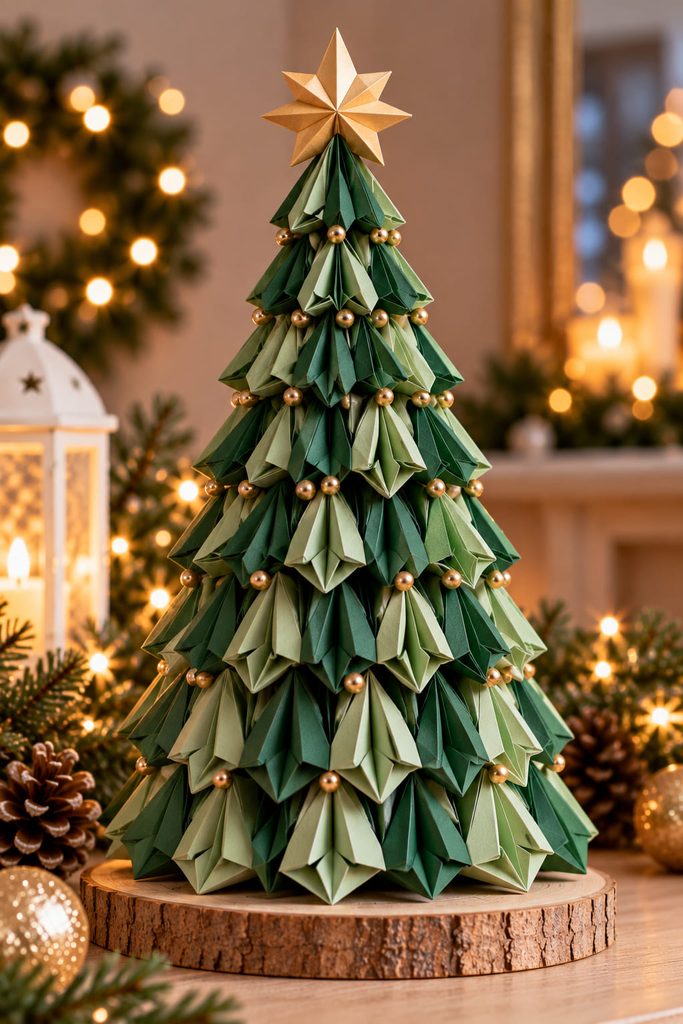
For true sculptural depth, modular origami is one of the richest approaches. Instead of forming one shell, you build many repeated units and connect them into a tree with visible body and texture. That repetition gives the piece density, while the interlocking structure creates a shape that feels deliberate and engineered rather than simply decorated.
This is the most time-intensive option in the group, but it rewards patience with the strongest sense of “real dimension.” It also offers the clearest scaling path: add more units for a fuller tree, reduce them for a more open structure, or use color changes by section to emphasize layers.
If you like projects that feel meditative and a little technical, this is a satisfying choice. Just keep your unit folds consistent. In modular work, small inaccuracies multiply quickly, so precision matters more than speed.
FAQs About 3D Paper Christmas Trees
What paper works best for 3D paper Christmas trees?
Medium to heavy cardstock is usually the safest all-around choice because it holds folds, stands more cleanly, and resists sagging. Lighter paper works well for honeycomb and some fan-fold designs, while specialty papers like vellum or book pages are better when the structure already has enough support.
Which 3D tree style is easiest for beginners?
Accordion trees and slotted standing trees are usually the easiest starting points. They use simple mechanics, do not require dozens of repeated pieces, and still give you a finished result that clearly looks dimensional.
How do I make a paper tree stand up better?
Start with a wider or more secure base than you think you need, especially for tall or narrow designs. Hidden tabs, layered bottoms, internal supports, or a mounted trunk section can all help. Trees that look light at the top can still tip if most of the structure rises too vertically.
Can I use these ideas for table centerpieces?
Yes, especially honeycomb trees, stacked cone trees, vellum luminaries, and rosette trees. For a centerpiece, choose a design that has good presence from multiple angles rather than one that depends on a front-facing profile.
Do 3D paper Christmas trees store well after the holidays?
Some do much better than others. Accordion and certain slotted designs can fold or disassemble easily, while modular, quilled, and woven trees are usually better stored as finished objects in a sturdy box.
What is the best option if I want the tree to glow?
A vellum luminary tree is the clearest choice because it is designed around light transmission. Use cool LED tea lights or battery-operated fairy lights so the paper stays safe.
Choosing The Right Tree For Your Holiday Style
If you want the quickest win, start with an accordion fold or slotted standing tree. If you want something more decorative and sculptural, layered cardstock, vellum luminaries, and modular origami give you stronger depth and more presence. And if texture matters as much as shape, woven, quilled, and book-page versions bring a lot of character to the finished piece.
If you want even more seasonal inspiration beyond trees alone, the next helpful read is 18 Paper Christmas Tree Ideas for Every Kind of Holiday Decor. It broadens the theme into more Christmas tree-inspired paper decor, which is useful if you want a mix of quick projects and statement pieces.