This post contains affiliate links. As an Amazon Associate I earn from qualifying purchases, at no extra cost to you. Thank you for supporting Diynify!
A cardboard gingerbread house gives recycled boxes a surprisingly natural holiday role: kraft-brown board already resembles baked gingerbread, while white paint, paper trim, and exposed corrugated edges can stand in for icing and cookie texture. These ideas focus on structures you can actually display—freestanding houses, fold-flat scenes, wall pieces, a luminary, an advent cabinet, and more.
Most projects use clean corrugated cardboard or cereal-box board, a cutting mat, a metal ruler, a sharp craft knife or sturdy scissors, and paper-safe glue. A few need extras such as vellum, thread, a photo, or a cool battery-powered LED. Build the structure first; add the “frosting” only after the walls, folds, slots, and supports work.
1. Reinforced Classic Gable House Centerpiece
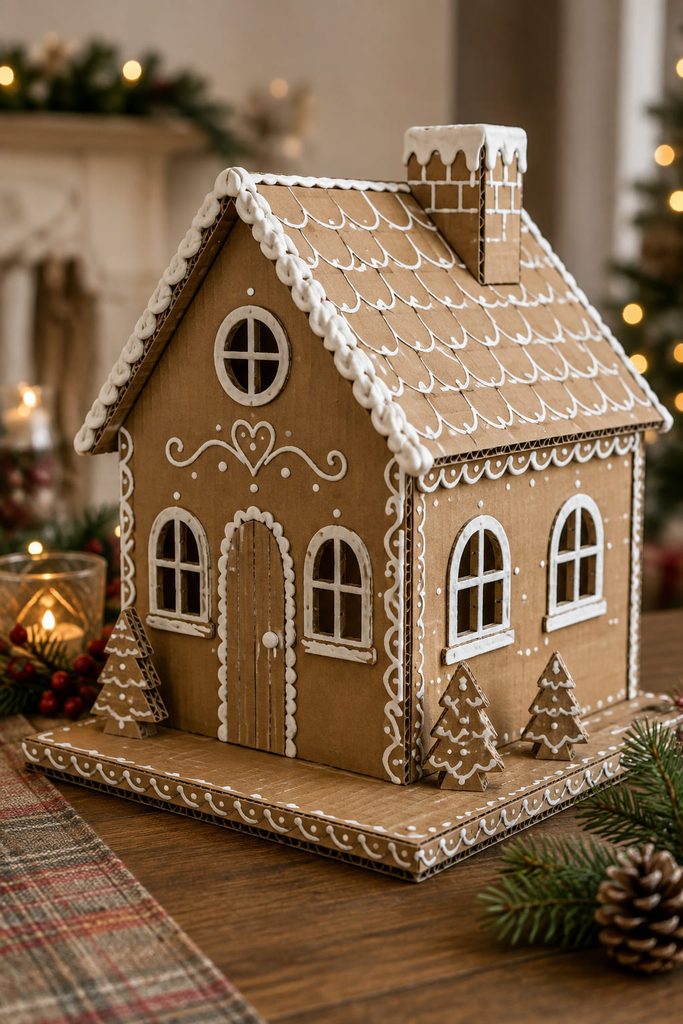
Start with the familiar silhouette when you want one substantial house to anchor a table, console, or mantel. Cut four corrugated wall panels, join them with interior tabs, and use a separate two-piece roof rather than forcing thick board over one ridge.

The useful upgrade is hidden inside. Narrow angle braces keep the lower corners square, while a flat floor panel stops the shell from spreading. Finish with white painted “icing” only after those hidden supports hold the house without help.
2. Slot-Together Fold-Flat Gingerbread House
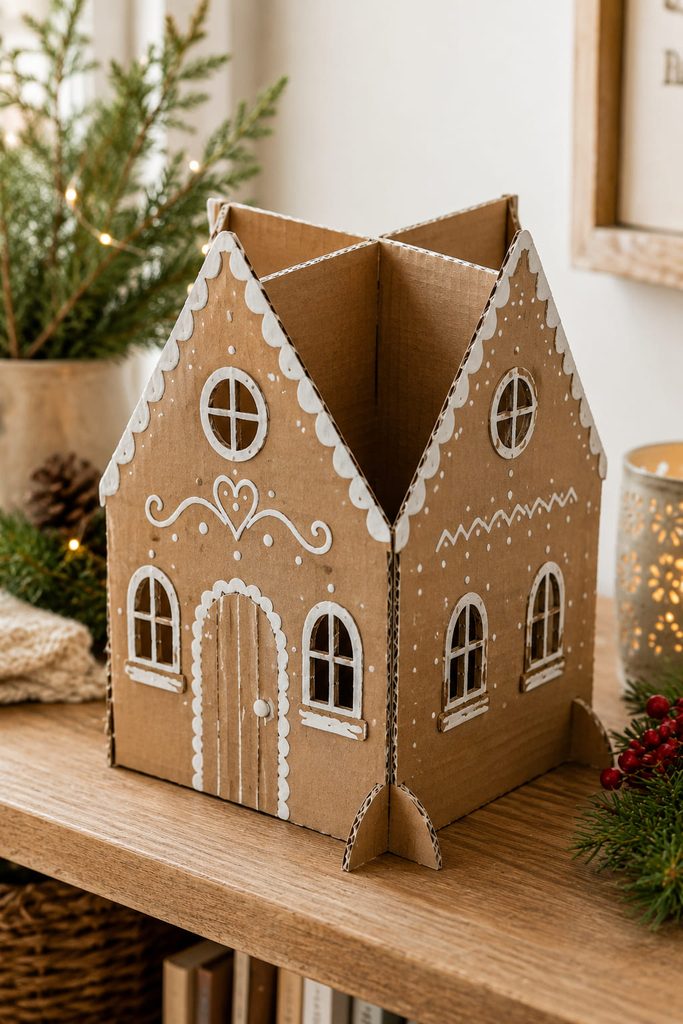
Need a house that packs flat after Christmas? Instead of a glued box, cut a front-and-back house profile plus two side profiles, then give the pieces centered slots so they intersect at right angles. The crossing planes create the footprint, and the entire display can come apart for storage.
Assembly order matters:

- Cut the four outer profiles while the cardboard is flat.
- Test the slot width on scrap from the same box.
- Slide the main profiles together before adding roof-edge trim.
- Add a small removable base collar only if the intersection feels loose.
- Disassemble the house once to confirm decorations do not block the slots.
Keep bulky “gumdrop” details away from the slot paths. A fold-flat project only earns its storage advantage if the parts can still separate cleanly after decorating.
3. Open-Front Gingerbread Bakery Display
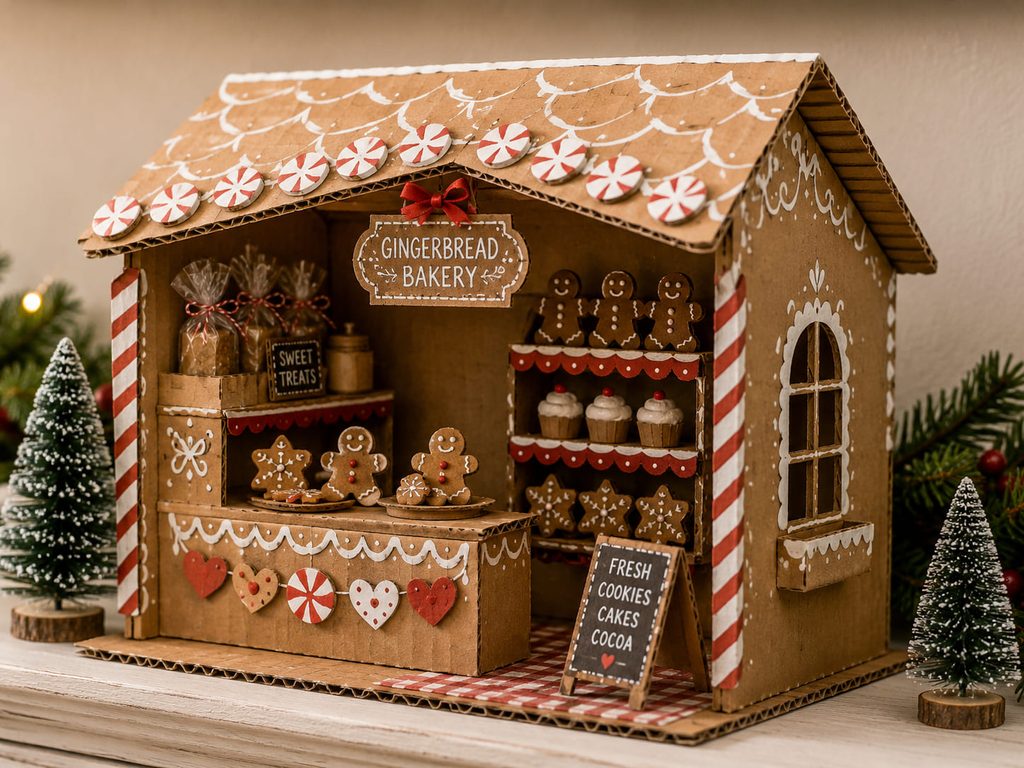
Turn the house into a miniature stage by leaving the front wall mostly open. A three-sided shell with a roof and a shallow floor gives you enough enclosure to read as a gingerbread cottage, but the open face lets a tiny cardboard counter, shelves, cookie shapes, or wrapped candy props remain visible.
The floor is doing more work than it seems: it locks the two side walls at a fixed distance and gives interior pieces something to attach to. For a deeper “shop window” effect, bring the roof forward slightly past the open edge and keep the interior background simple. Too many small pieces make the opening look cluttered; one counter and one or two strong display zones usually read more clearly from across a room.
4. LED Window Gingerbread House Luminary
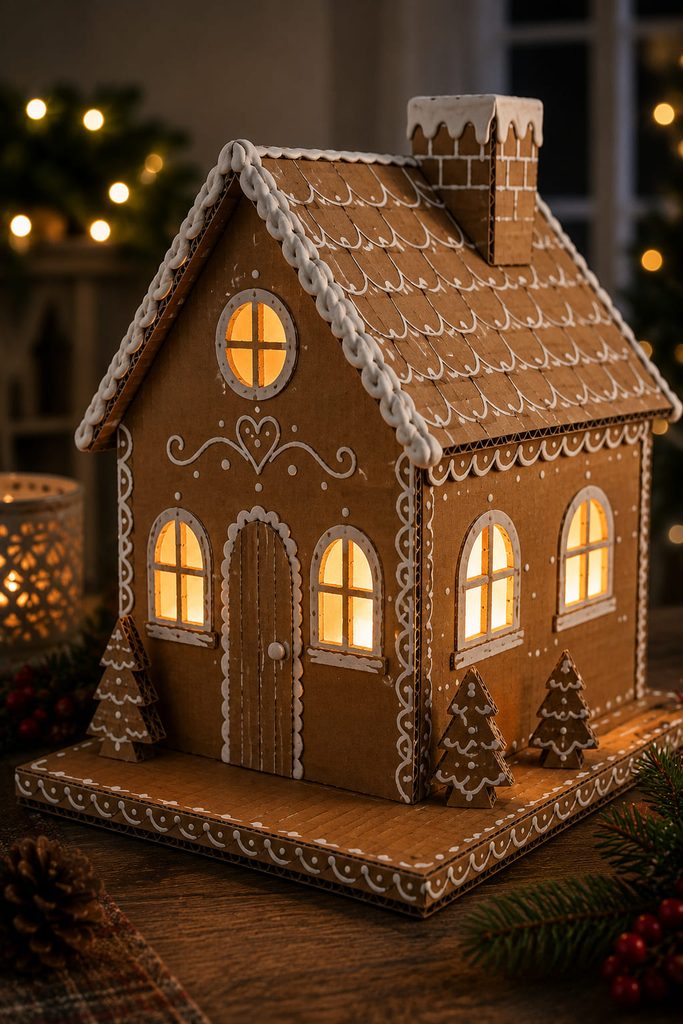
A glowing cardboard house needs a real light path, not windows painted yellow on a closed box. Cut generous window openings before assembly, back them with vellum or thin translucent paper, and keep the interior free of braces that cross those openings. The shell should stand on a closed, stable base so the light source cannot tip the house.
Use only a cool battery-powered LED—never an open flame—and plan access before gluing the roof. A removable roof panel, hinged back flap, or wide rear door lets you insert, switch on, and remove the LED without crushing the walls.
Keep The Light Path Open: Set the unlit house over the LED in a dim room before adding frosting trim. If one side looks much darker, check for an interior brace, low window placement, or opaque glue smear rather than simply adding more openings.
For the cleanest glow, choose fewer larger windows instead of many tiny cutouts. Corrugated cardboard loses strength quickly when narrow strips remain between openings. If a window wall flexes, laminate a thin inner frame around the perimeter while leaving the translucent center clear.
5. Accordion Gingerbread Street Mantel Backdrop
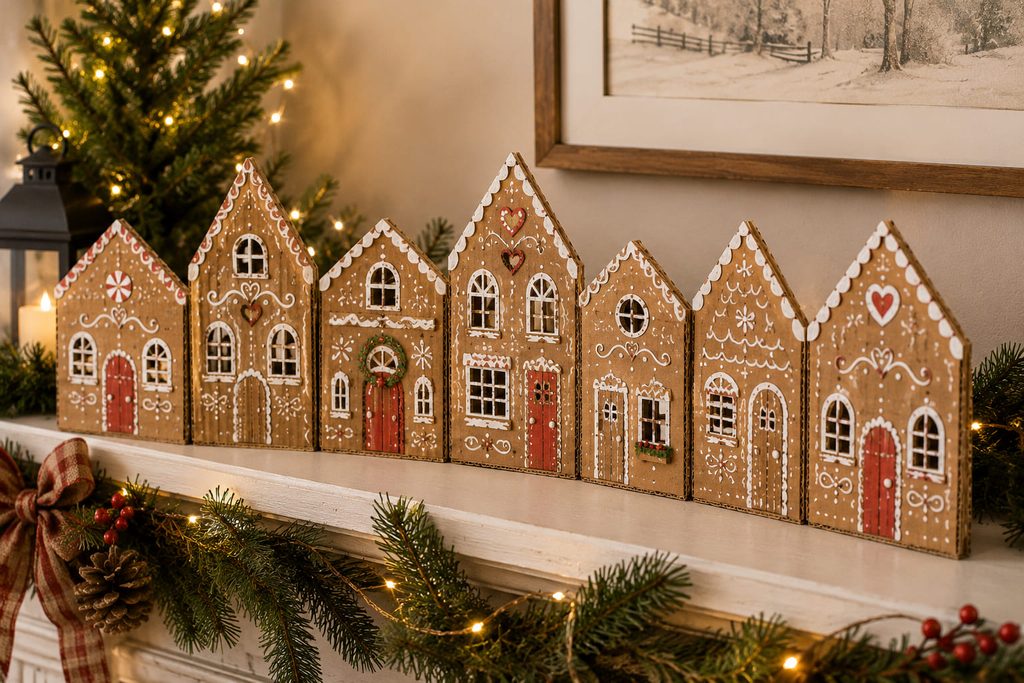
One scored strip can create a whole gingerbread “street” without requiring a row of separate boxes. Cut roof peaks across thinner cardboard, mark vertical fold lines between the house fronts, and accordion-fold the strip so alternating panels angle forward and back. Those folds become the feet.

Work while the strip is still flat whenever possible:
- Mark every fold.
- Cut the roofline and outer silhouette.
- Score and form the accordion.
- Stand the strip to find which faces are most visible.
- Add doors, windows, and icing lines to the stable front-facing panels.
Avoid placing large window openings directly across a fold. The crease is what keeps the backdrop standing, so removing material there weakens both the geometry and the visual rhythm.
6. Layered Corrugated Gingerbread House Wall Plaque
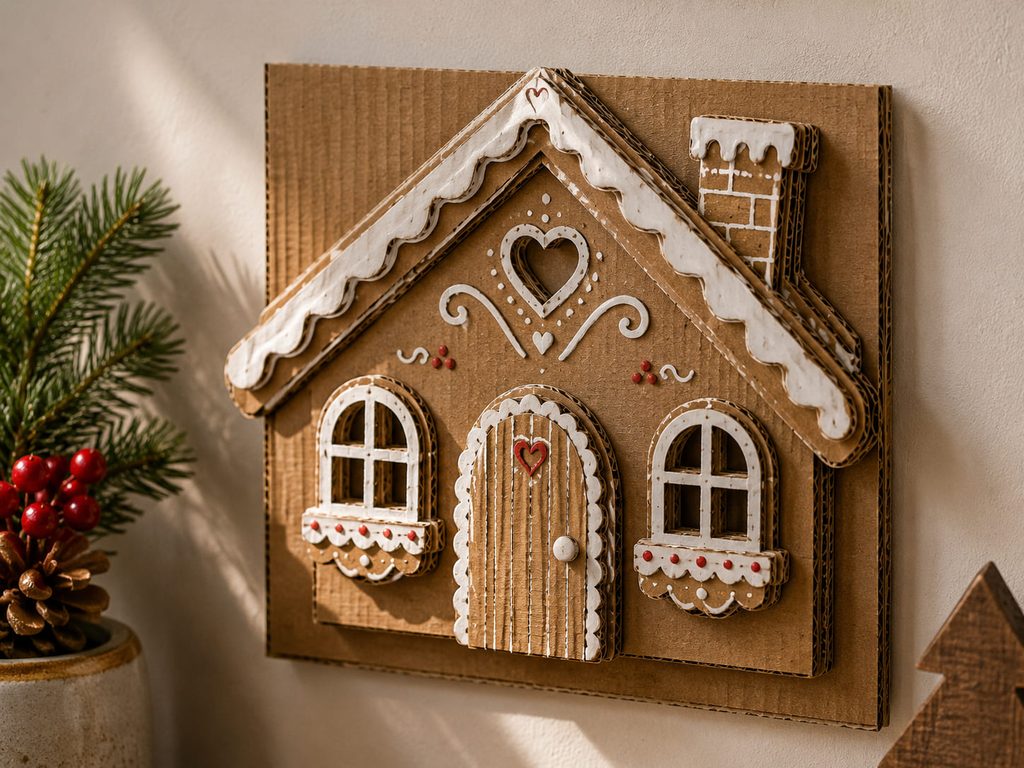
Let the corrugated edges become the decoration. Laminate two or three house silhouettes on a flat backing, reducing each front layer so exposed flutes create a stepped cookie edge around the roof and doorway.
Rotate the flute direction between layers when the board allows it. For hanging, attach the cord or hardware to the backing rather than a decorative roof tip, and keep the deepest relief near the center. Bold trim will read better at wall distance than dozens of tiny pieces.

7. Pop-Up Gingerbread House Book Display
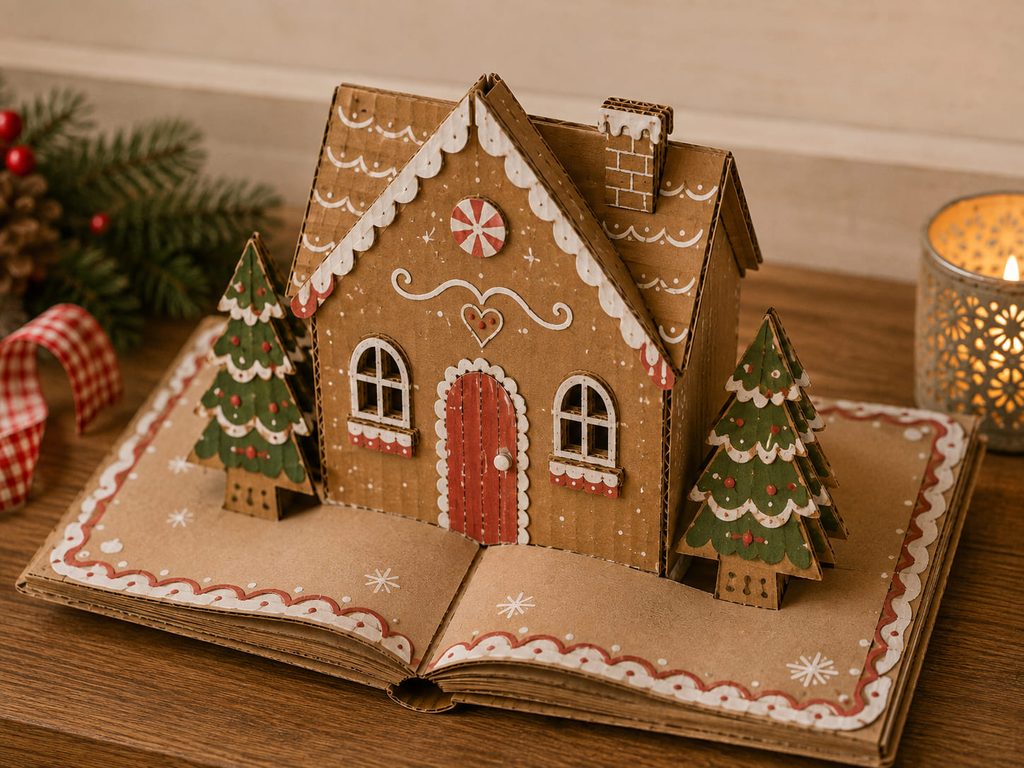
This house begins flat and becomes dimensional only when two base panels open like a book. Score a center hinge in a sturdy base, then attach the house walls with V-fold or parallel-fold paper hinges so the facade rises as the base opens. The roof can be split along the ridge, allowing each half to travel with its wall instead of fighting the fold.
Build the moving geometry before adding any decoration. Keep the hinge glue zones reachable while the base is open, then open the base to 90 degrees, close it completely, and watch where the roof edges, chimney, and side walls travel. Nothing should collide or extend beyond the closed footprint.
If the house leans forward when open, shorten the hinge depth or move the lower attachment slightly back rather than adding a visible prop. The useful test is the closed state: a true pop-up display should collapse without buckling, then return to the same standing position when reopened.
8. Gingerbread House Holiday Photo Frame
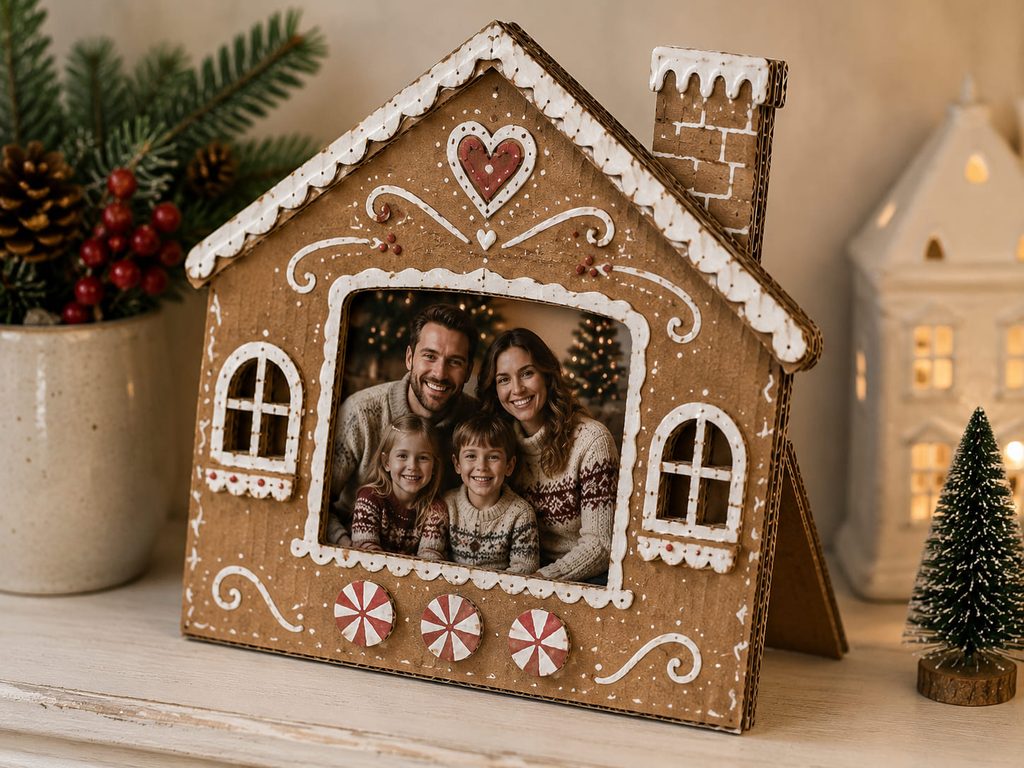
On a shelf, the holiday photo feels built into the display when the picture opening becomes one of the house windows. Cut a sturdy front panel, laminate a second layer around the opening for depth, and trap the photo behind it with corner tabs or a three-sided pocket so the print can be replaced later.

Before finishing the front, check four things:
- the photo opening is smaller than the print on every side;
- the rear pocket leaves one edge accessible;
- the easel leg opens far enough to resist tipping;
- heavy roof decorations stay above the support point, not far in front of it.
Treat the easel as part of the structure. A narrow prop leg under a wide house facade can twist; a broader triangular rear support gives the frame a more dependable footprint on a shelf.
9. Mini Hanging Gingerbread House Ornament

When the house shrinks to ornament size, cardboard choice and hanging load matter more. Use cereal-box board or thin single-wall cardboard so the ornament stays light, and reinforce the hanging point before closing the roof. A short loop of thread or narrow ribbon should pass through a doubled roof-ridge tab or an interior crosspiece rather than through a single punched hole near the edge.
Keep the silhouette simple: one door, two windows, a roof border, and perhaps a tiny chimney. Heavy layered candy pieces pull a small house off balance and make it turn sideways on the tree. Hang the unfinished shell once before decorating; the roof ridge should settle level enough that the front remains visible.
10. Tunnel-Layer Gingerbread House Shadow Box
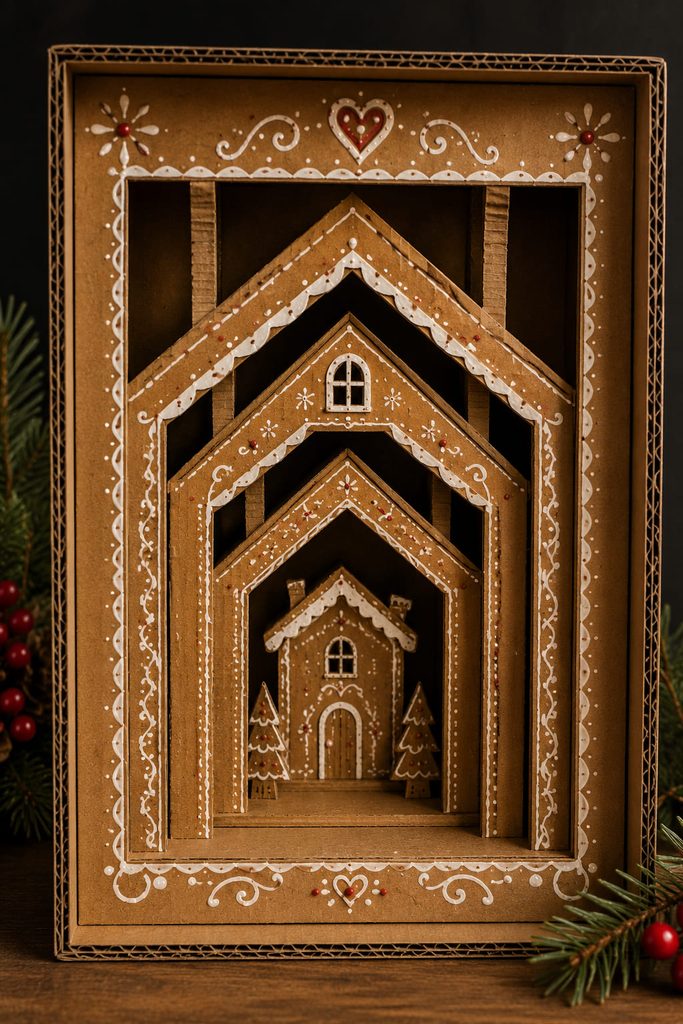
For front-facing depth without building a full 3D cottage, use repeated house-shaped openings like a paper theater. A deep rectangular frame holds several cardboard layers separated by narrow spacers: an outer gingerbread facade, a second interior arch or window layer, a smaller house silhouette, and a quiet backing scene.

There are two useful ways to create the depth:
| Route | Best For | Main Trade-Off |
|---|---|---|
| Separate cardboard spacers between every layer | Strong, readable shadows | A deeper frame |
| Laminated relief only on selected foreground pieces | Shallower shelf profile | Less dramatic separation |
Protect the negative space. The openings are what make the tunnel readable, so frosting trim belongs around the edges rather than bridging across the view. Dry-stack all layers before gluing; if the inner house disappears, increase the spacing or simplify the nearest opening instead of adding more detail.
11. Gingerbread House Advent Calendar Cabinet
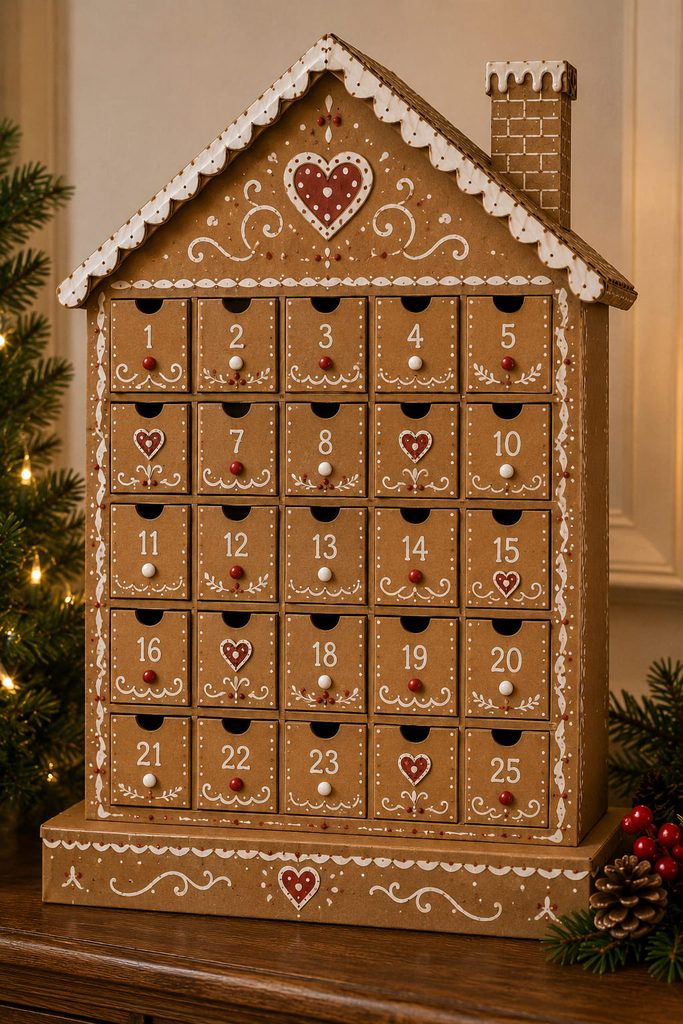
Every compartment changes the build: an advent house is closer to small furniture than to a simple decoration because each opening has to remain usable. Build a rigid outer carcass first—floor, two sides, back, and roof—then fit horizontal and vertical dividers into a square grid so the small doors or drawers do not bind.
Choose one access system and commit to it. Hinged doors need clearance to swing; shallow pull-out boxes need slightly smaller dimensions than their openings plus a finger tab. Mixing both across one facade makes alignment harder without adding much value.
A practical build sequence is:
- Assemble and square the empty outer house.
- Fit the divider grid without fronts.
- Test one complete door or drawer as the sizing sample.
- Repeat the remaining compartments from that sample.
- Load only lightweight notes, paper activities, or small wrapped items that fit without forcing the openings.
- Add facade trim after every compartment operates.
Drawer Clearance Check: If a drawer catches, sand or trim the drawer—not the structural divider—unless the entire row is misaligned. Preserving the grid keeps neighboring compartments from developing the same problem.
The roof and base should carry the visual gingerbread treatment, while the compartment fronts stay legible as separate access points. This is one project where decorative “icing” that crosses a seam can turn into a functional obstruction.
12. Modular Stackable Gingerbread House Village
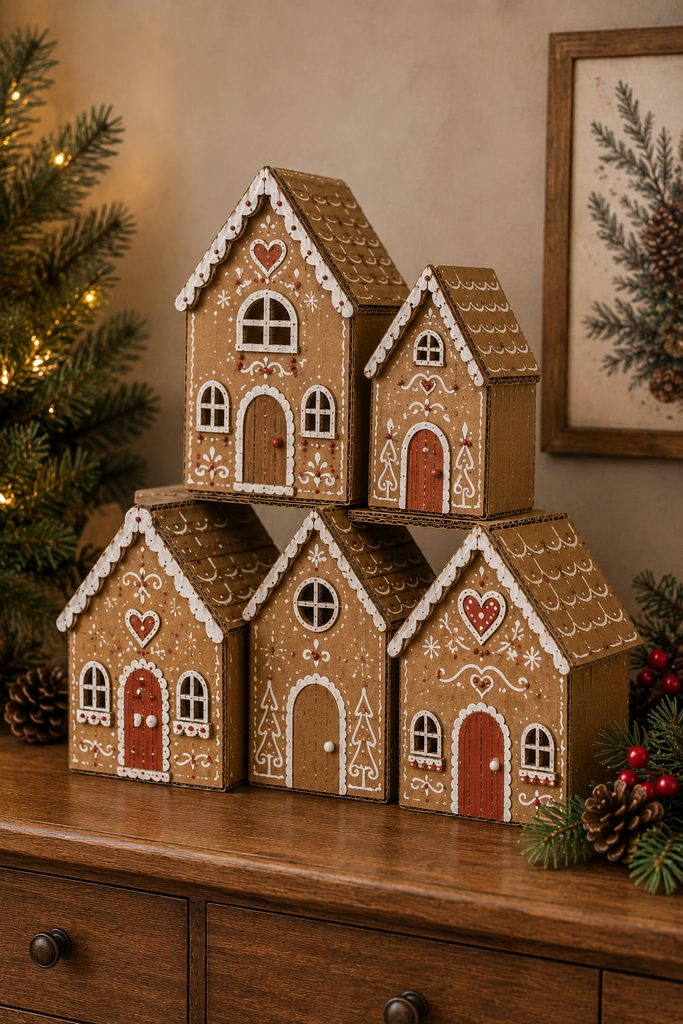
Make the display rearrangeable by treating each house as a lightweight closed module rather than gluing a village permanently to one base. Build several small box-form cottages with flat bottoms and mostly flat roof zones, then vary the facade heights, chimneys, and roof trim while keeping the footprint family consistent.
Stacking should remain shallow and intentional:
- Place the widest module at the bottom.
- Keep upper houses centered over supported walls rather than over hollow roof spans.
- Use small hidden cardboard registration tabs if pieces slide.
- Stop when the silhouette becomes top-heavy.
- Separate the modules for storage.
This works best as a low tiered arrangement, not a tall tower. The real benefit is flexibility: the same set can spread across a mantel one year and cluster on a console the next without rebuilding the houses.
13. Oversized Gingerbread House Photo Backdrop
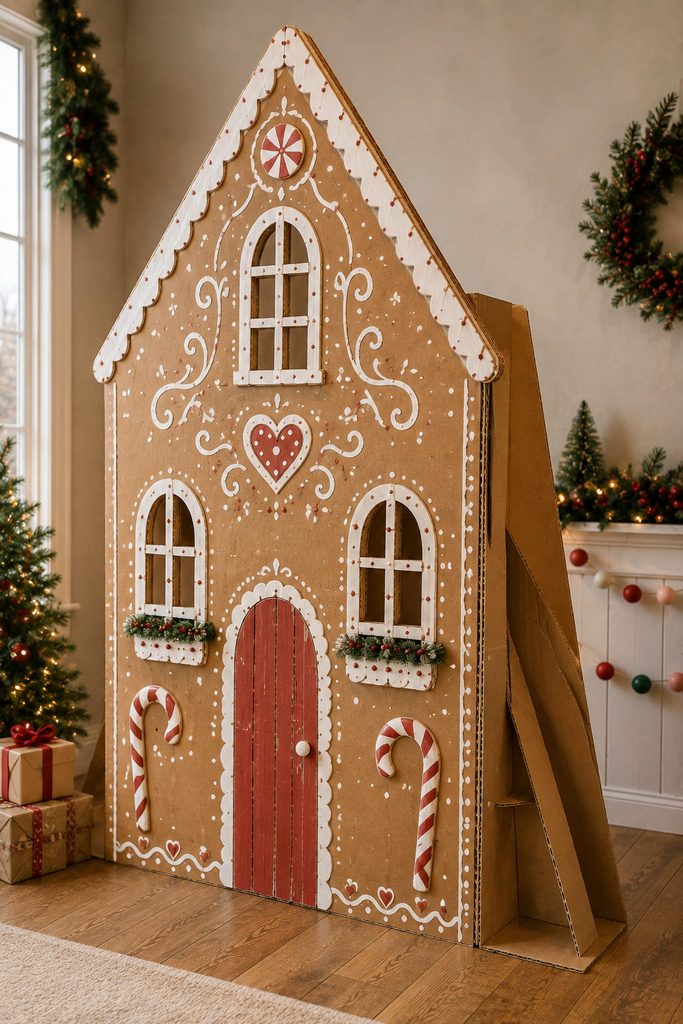
At floor scale, the front facade becomes a sign-like structure and needs support behind it. Cut the house front from large corrugated panels, reinforce seams with overlapping strips on the back, and use broad triangular feet or box-shaped rear braces so the panel cannot rely on the wall for balance.
Design for camera distance. A few oversized windows, a bold scalloped roof edge, and thick white icing lines show up better in photos than miniature candy details copied from a tabletop house. Keep cutouts away from panel seams and support points.
Footprint Before Frosting: Stand the undecorated facade in its final location and gently press near the upper corners. If the feet lift or the panel twists, enlarge the rear braces before adding surface weight. Decoration should never be the part holding a human-scale cardboard display upright.
If people will pose near it, keep the facade as background decor rather than a load-bearing prop. Do not design doors, ledges, or openings that invite climbing or leaning on cardboard.
14. Fold-Flat Gingerbread House Place Card Stand
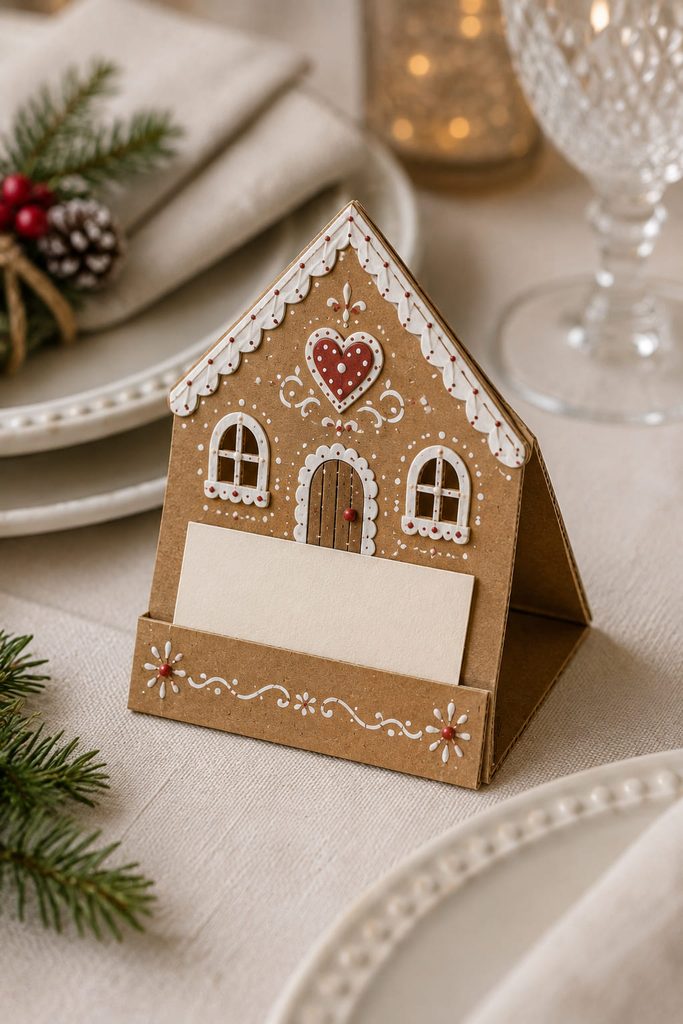
For a holiday table, a miniature house can do more than sit between plates. Cut one long strip of cereal-box board, score it into a front facade, narrow roof ridge, and rear support panel, then fold it into a stable triangular stand. A small horizontal slit or glued paper pocket on the front holds a removable name card.
The common failure is too much weight on the facade. If the stand keeps tipping forward, move thick roof trim to the rear edge, shorten the front overhang, or widen the footprint instead of gluing coins or hidden weights inside. A place card stand should remain light enough to store flat once the insert is removed.
15. Balanced Gingerbread House Window Mobile
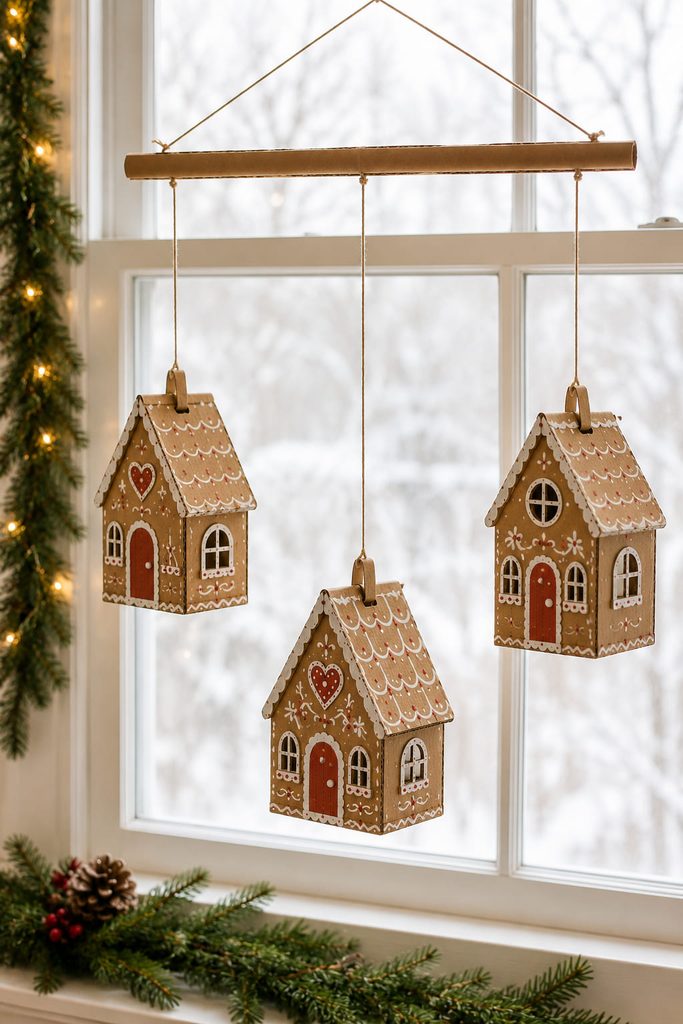
Once the houses leave the tabletop, bad weight distribution shows up in every tilt. Suspend two or three lightweight cardboard houses from a horizontal dowel or stiff cardboard beam, using separate thread lengths and attachment points so the pieces hang without colliding. Each miniature house needs its own reinforced roof loop just like an ornament.
Balance the beam before adding decorative extras. Slide the hanging points toward or away from the center until the beam settles close to level, then check clearance through a full gentle rotation.
Where The Weight Goes: If one house keeps pulling the mobile down, shorten its lever arm by moving its thread closer to the center before making the opposite house heavier. Adding random counterweights increases total load and can create a new imbalance.
Place this mobile where air can move around it but where the houses are not repeatedly striking a window, wall, or light fixture.
16. Gingerbread House Christmas Card Display Stand
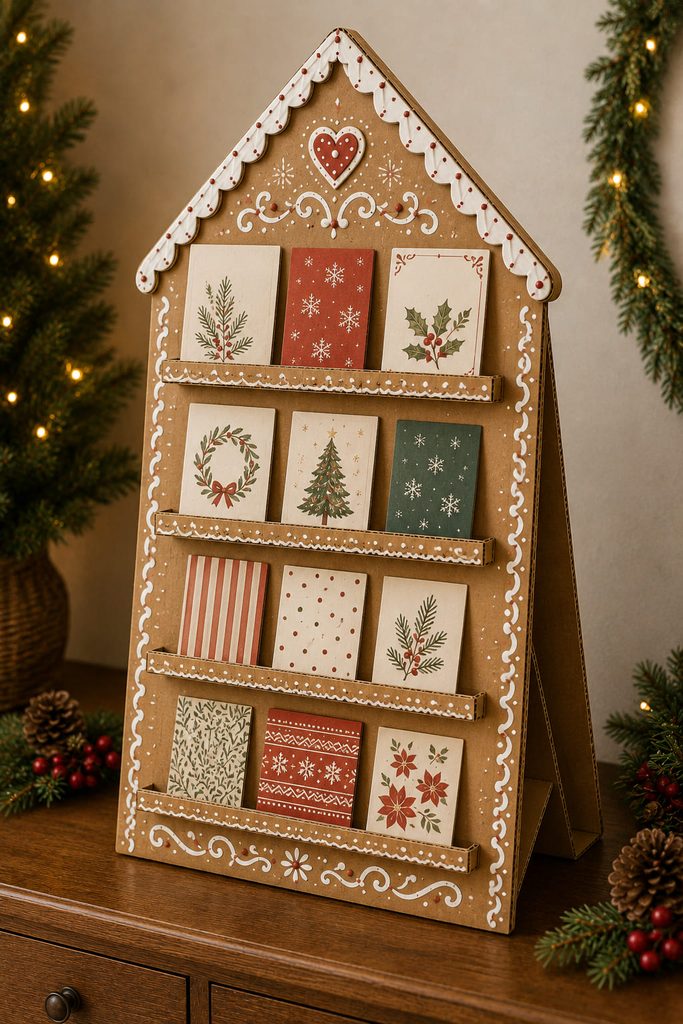
Instead of stacking incoming Christmas cards, build the holding system into a house-shaped backboard. Start with a wide corrugated facade and add a rear easel or two triangular feet. Across the front, attach shallow horizontal ledges with small retaining lips, spacing them far enough apart that cards can lean without covering the row above.
Check the stand by function before decorating it:
- the base remains wider than the loaded upper area;
- each ledge is supported at both ends or along its full back edge;
- cards slide in and out without catching on icing trim;
- the uppermost ledge is shorter than the lower ones;
- the stand can be lifted from the main backboard without the ledges peeling away.
A roofline and window shapes make the organizer read as a gingerbread house, but the card edges should remain the visual activity. Keep the frosting pattern mostly on the outer frame so it does not compete with the greetings being displayed.
17. Cardboard Gingerbread House Wreath
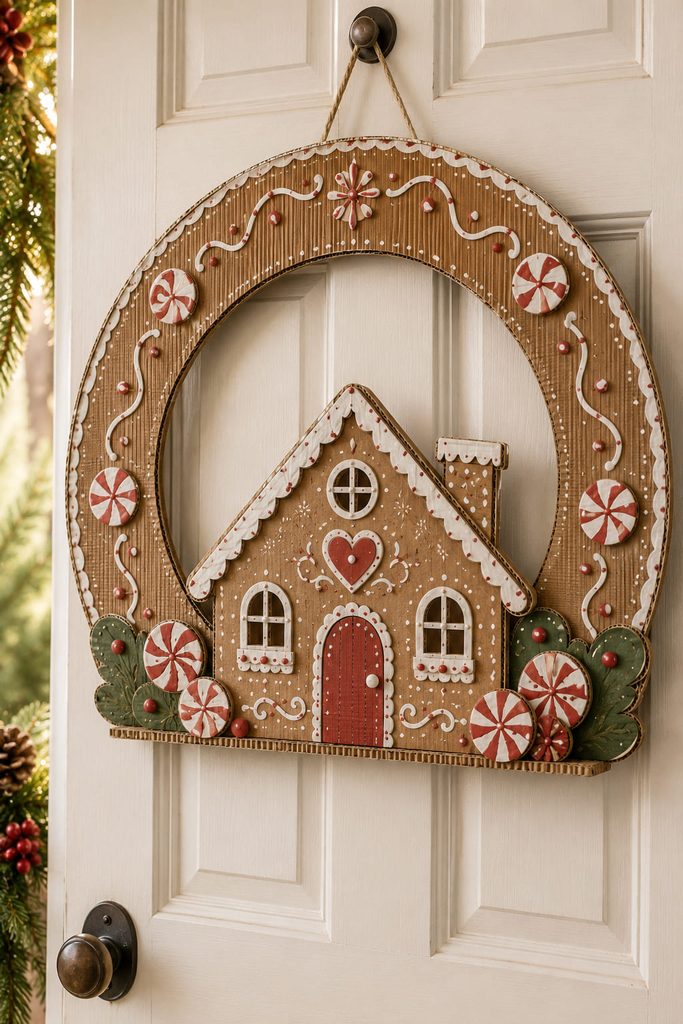
Mounted on a door or wall, the house motif becomes a flatter alternative to another freestanding cottage. Cut a broad ring from sturdy corrugated cardboard, laminate a second ring if the first flexes, then mount one shallow house facade across the lower third so its roofline breaks the circle.
The ring carries the hanging load; the house is a decorative relief. Attach the hanger to the reinforced ring itself and keep the heaviest layered details close to that plane. A few cardboard peppermint disks or white painted scallops can bridge the ring and facade visually, but leave open space around the upper arc so the house silhouette remains clear.
For a flatter storage profile, keep all candy details laminated rather than sculpted. The wreath can then slide into a shallow box without crushing projecting pieces.
Choosing Cardboard That Behaves Like A Building Material
The easiest way to improve any of these projects is to match the board to the job. Thin cereal-box board bends cleanly for small ornaments, place cards, and pop-up hinges. Single-wall corrugated cardboard works well for most freestanding houses and wall pieces. Stiffer double-wall board is more useful for large backdrops and bases, but its thickness makes tight folds and small windows harder to cut.
Score fold lines instead of forcing thick cardboard to crease sharply. When a panel must stay flat, orient long folds and supports with the board’s flute direction in mind and reinforce weak openings from the back. For faux icing, opaque white craft paint or a paint marker keeps the surface light; thick wet coatings can warp thin board.
Pick The Structure Before The Candy Details
The best first project depends on what you need the finished piece to do. Choose the classic gable house for a traditional centerpiece, the slot-together or accordion version when storage matters, the luminary when light is part of the display, and the photo frame or card stand when the house needs a second function.
If you have more shipping boxes than gingerbread-house ideas, continue with 16 Festive Cardboard Christmas Decorations From Recycled Boxes for ornaments, wall pieces, wreaths, standing sculptures, and other ways to let corrugated texture stay visible instead of covering it.